
Neel Shelat assesses how one of Bulgaria’s most decorated club built a relationship with South American talent and what the current state of that relationship is
One of the biggest stories of the 2025/26 season outside of the big leagues has to be the title race in the Bulgarian top flight. Defending champions Ludogorets Razgrad have won each of the last 14 titles, but they are currently seven points off the top spot. That means they are at risk of missing out on setting a new European men’s record and equalling the world record for most consecutive top-flight league wins.
The origins of Ludogorets’ era of dominance can be traced back to 2010, when the club was taken over by then-multimillionaire (and now billionaire) Kiril Domuschiev. While traditional giants of the domestic football scene struggled with financial issues and mismanagement among other things, the Eagles’ newfound wealth placed them in a class of their own. They won the domestic double in 2011/12, their first season after winning promotion from the second tier. Since then, they have never loosened their grip on the league title.
Naturally, Ludogorets’ financial dominance has translated to a significant talent advantage on the pitch. They have largely enacted this through foreign player recruitment from different parts of the world. In fact, just one Bulgarian player has started more than five league matches for them this term, and only one domestic player features in the top ten of their all-time top-scorers list.
As is the case for many clubs of similar stature all around the world, Ludogorets have often turned to Brazil to bring in key players. Indeed, two of their three all-time top scorers came from the country. Overall, 25 Brazilians have represented the club thus far, over four times as many as the second-most represented nationality (Romania, 6).
Clearly, Brazilian players have played a big part in Ludogorets’ success, and the results so far indicate little need to question their strategy. However, as their incredible streak is at serious risk of being broken, it is now definitely worth looking at whether they have gotten the most value out of this pathway.
Overall track record
Before getting into the numbers, it is worth noting that this dataset doesn’t include all Brazilian-born players to have featured for Ludogorets. The reason behind that is the fact that a few were given Bulgarian citizenship and naturalised to be called up to the Bulgarian national team, causing their nationality to be switched to Bulgaria. As a result, they are difficult to filter for, but only represent a small proportion. Marcelinho and Wanderson — the aforementioned duo who feature in Ludogorets’ all-time top-scorers list — are among them. Needless to say, their moves have to be considered very successful. Some of the players in our dataset were also granted Bulgarian citizenship, which allowed the club to work around the league’s foreign player quota regulations, but their primary nationality remains Brazilian since they never featured for the Bulgarian national team. So, this piece will focus on those 25 Brazilians.
Here are some of the topline stats surrounding these players and their transfers:
Total Transfer Fees Paid: €16.71m
Average Player Age at Time of Signing: 23.88 y/o
Average Number of Appearances Made per Player: 77.84
Total Transfer Fees Earned: €44.15m
At first glance, these numbers look quite impressive. The more than 2.5x difference between the total transfer fees perhaps stands out, but it is worth remembering that the player trading aspect isn’t necessarily always Ludogorets’ priority. Their financial situation is quite solid — certainly in contrast to their league rivals.
Additionally, they have done well to limit risks by avoiding going too big on individual players. A total of 16 Brazilian players fetched transfer fees when they moved to Ludogorets, with figures ranging from €2.2m to €200,000 and averaging at just over €1m.
Indeed, only three of the club’s top 10 signings by expenditure are Brazilian: Jonathan Cafu (3rd), Nonato (7th), and Caio Vidal (8th). The latter two were both signed from Internacional in 2022/23, while Cafu was plucked from São Paulo in 2015/16; the combined total of the signings was a paltry €5.5m.
This, of course, means that while playing trading might not be the most significant factor in the club’s transfer strategy, it certainly doesn’t hurt the bottom line. And while only three Brazilians are in the top expenditure list, six of Ludogoret’s top 10 outgoing fees received have been from Brazilians; they account for 70% of the revenue from those 10 fees, and 74% of the profit (not including wages or bonuses).
| Player | Primary Nationality | Signed from | League | Fee / €m | Sold to | League | Fee / €m |
| Igor Thiago | Brazil | Cruzeiro | Serie B (B) | 1.32 | Club Brugge | JPL | 11.0 |
| Rwan Cruz | Brazil | Santos | Serie A (B) | 0 | Botafogo | Serie A (B) | 10.0 |
| Jonathan Cafu | Brazil | São Paulo | Serie A (B) | 2.20 | Bordeaux | Ligue 1 | 7.50 |
| Rick | Brazil | Ceará SC | Serie A (B) | 0.75 | CA Tallares | Clausura | 5.85 |
| José Luis Palomino | Argentina | Metz | Ligue 1 | 0 | Atalanta | Serie A | 4.70 |
| Júnior Caiçara | Brazil | Santo André | Serie D (B) | 0.30 | FC Schalke 04 | Bundesliga | 4.50 |
| Virgil Misidjan | Suriname | Willem II | Keuken Kampioen | 0.70 | 1. FC Nuremberg | Bundesliga | 3.00 |
| Jakub Piotrowski | Poland | F. Düsseldorf | 2. Bundesliga | 1.30 | Udinese | Serie A | 3.00 |
| Kiril Despodov | Bulgaria | Cagilari | Serie A | 1.70 | PAOK | Super League | 3.00 |
| Igor Plastun | Ukraine | Karpaty Lviv | Premier League | 0.80 | KAA Gent | JPL | 3.00 |
It is worth digressing slightly here to talk about the club transfer strategy as a whole: with regards to that top 10 of sales, the smallest profit was €1.3m and the largest was €10m. Interestingly, as well, while players came from Brazil’s Serié A, Ligue 1, and Italy’s Serie A, they also came from 2. Bundesliga, the Ukrainian PL, lower leagues in Brazil, and the Dutch second tier. All players were sold to sides in their nation’s respective top tiers, which while likely a given for a team’s biggest sales, indicates a strong process for talent identification as a development club.
In addition, of the top 10 fees paid, five are still at the club and two made profits, while only three made a loss of only €1.95m in total: Nonato (39 games played for the club, €750k loss), Brayan Angulo (36 games, €700k loss), and Jacek Góralski (93 games, €500k loss).
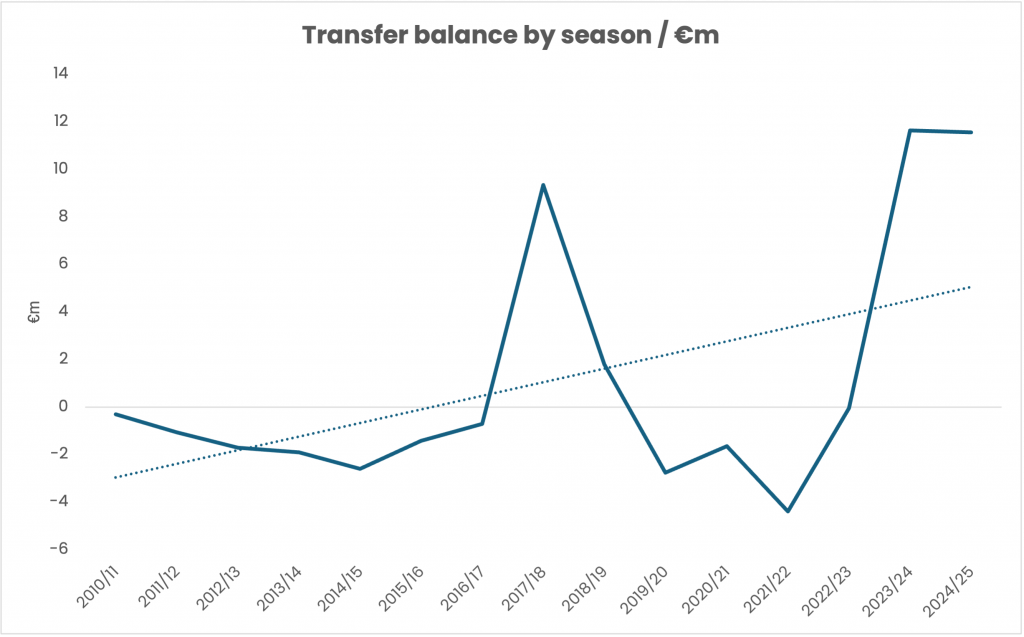
Ludogorets may be clearly identifiable for their Brazilian talent spotting, but this is a club that shops widely and well, frequently turning a profit on players, developing players coveted by larger teams in better leagues, and avoiding too many large losses (while also getting a decent amount of games even from the players who sell for a loss), while their transfer balance line trends upwards.
That said, trading is only one element: transferred players have to provide value while at the club, not when leaving it. Perhaps more important for Ludogorets, therefore, is the strong average of over 75 appearances per Brazilian player, which hasn’t been inflated by any outliers too much since the median is also 78. The club’s main intention behind most such signings is focused on sporting impact on the pitch, so this is a good reflection of that strategy.
That would also explain the average age of the Brazilian signings being close to 24 years old; Ludogorets look for players entering peak age. Just five of their Brazilians have been more than 25 years old when coming in, while the rest have all been older than 20. This shows a sharp difference to the approaches of many relatively well-off clubs in a few Asian leagues in particular (who tend to bring in older foreign players, such as Johor Darul Ta’zim), as well as sides like Shakhtar Donetsk (whose strategy heavily depends on young talent development, as we explored in a previous piece). Most Brazilian signings come direct from Brazil, too, where big squads mean a good number of solid pros who may not be destined for Europe’s elite but are battle-hardened and relatively inexpensive.
As a result, the majority of Ludogorets’ signings — including the more successful ones — have been consistent and serviceable performers rather than standout talents exploding onto the European stage. Juninho Quixadá, who is among the club’s top 15 all-time appearance-makers thanks to his seven-year spell in Bulgaria, is a prime example of this. However, that is not to say that Ludogorets have not had a couple of big hits.
Standout signings
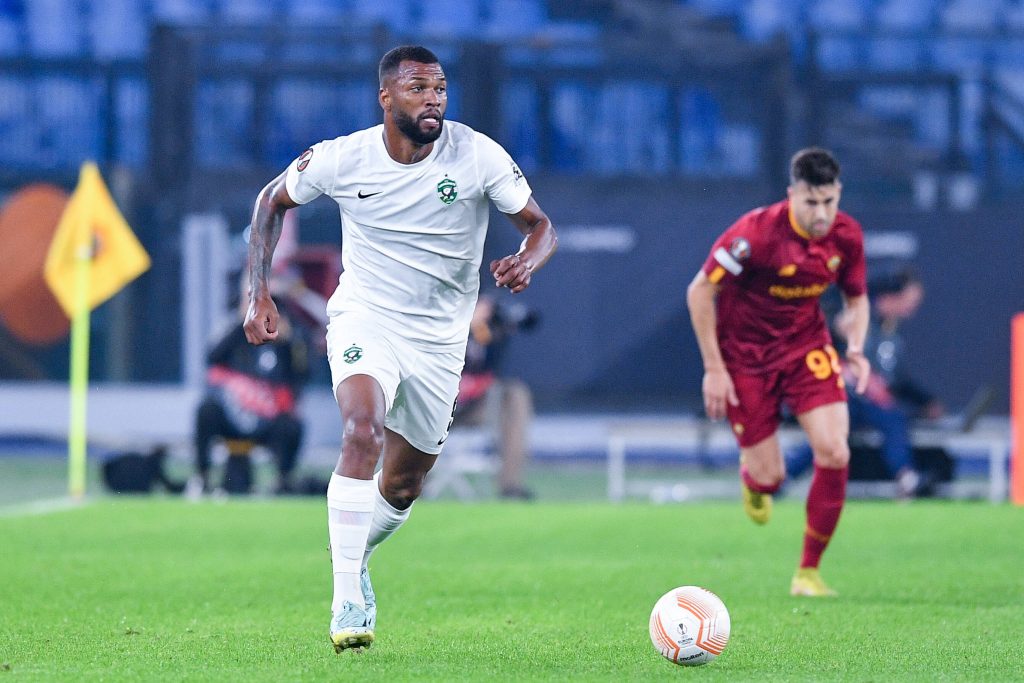
Certainly at the moment, the most internationally well-known Brazilian player to have represented Ludogorets is Igor Thiago (pictured at the top of this piece). The man who is currently second in the English Premier League’s scoring charts moved to Bulgaria from Cruzeiro. It was with the Eagles that he really captured everyone’s attention, putting together a 19-goal campaign in 2022/23 to earn a move to Club Brugge for a club-record departure fee of €11m.
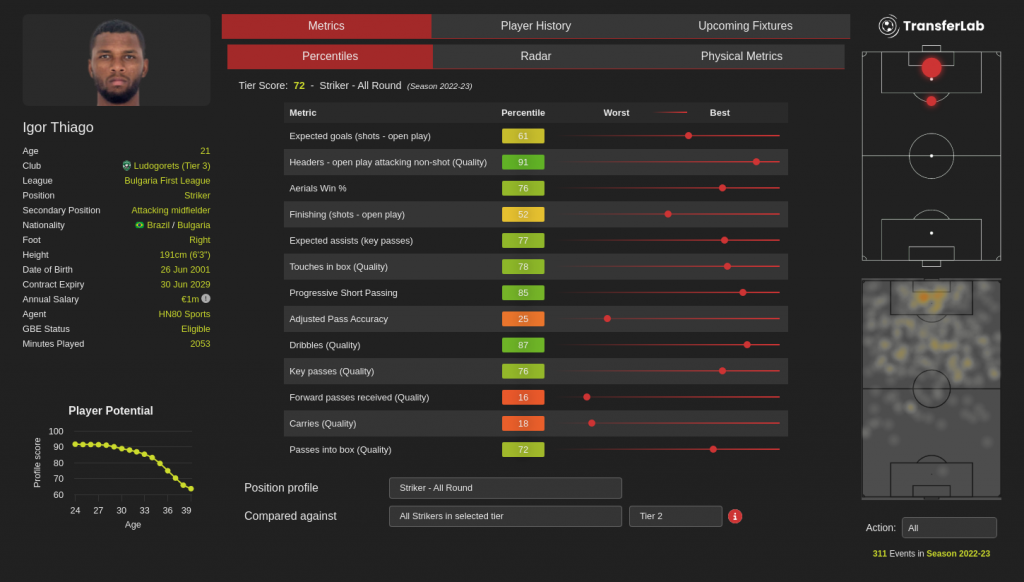
That figure was about nine times the amount they had paid for him, but the Belgian side would get thrice that amount from Brentford just a year later. Being the youngest Brazilian to have joined Ludogorets, he is a clear outlier in this dataset.
The only other eight-digit transfer fee Ludogorets have received has also been for a Brazilian player, though he did not go on to make such big leaps. The Eagles will surely have been pleased to receive €10m for Rwan Cruz from Botafogo in 2024, having signed him on a free transfer from Santos just a year prior. His numbers hardly look half as impressive as his predecessor’s, so it is no wonder that Botafogo fans have been questioning their management’s general decision-making a couple of years down the line.
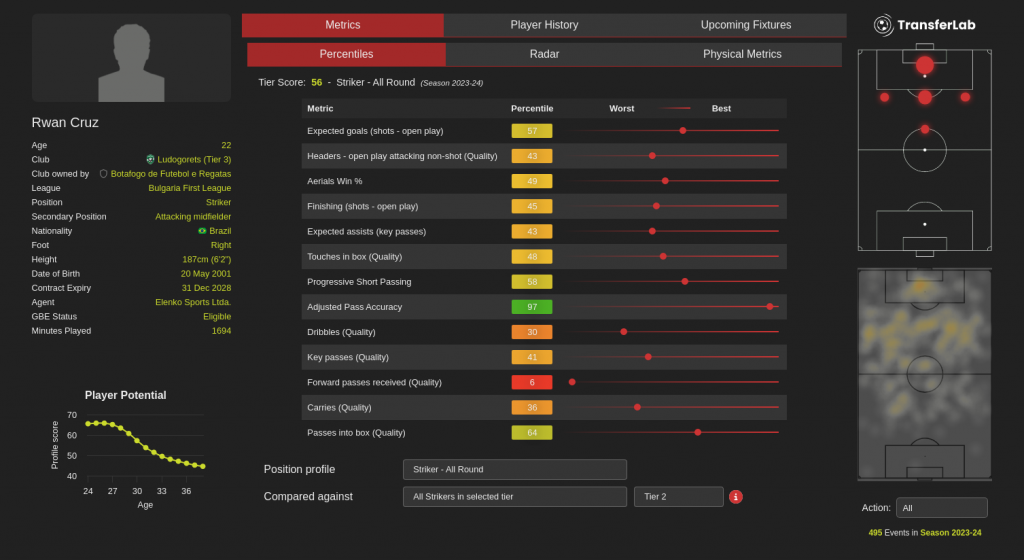
At 22 years old when he arrived, Rwan also falls on the younger side of Ludogorets’ Brazilian signings. In fact, all but one of the club’s top five Brazilian sales (who all feature in their top six overall sales) were aged under 23 when they came in. The only exception is 24-year-old Jonathan Cafú, whose €2.2m move from São Paulo keeps him the most expensive of his countrymen to join Ludogorets.
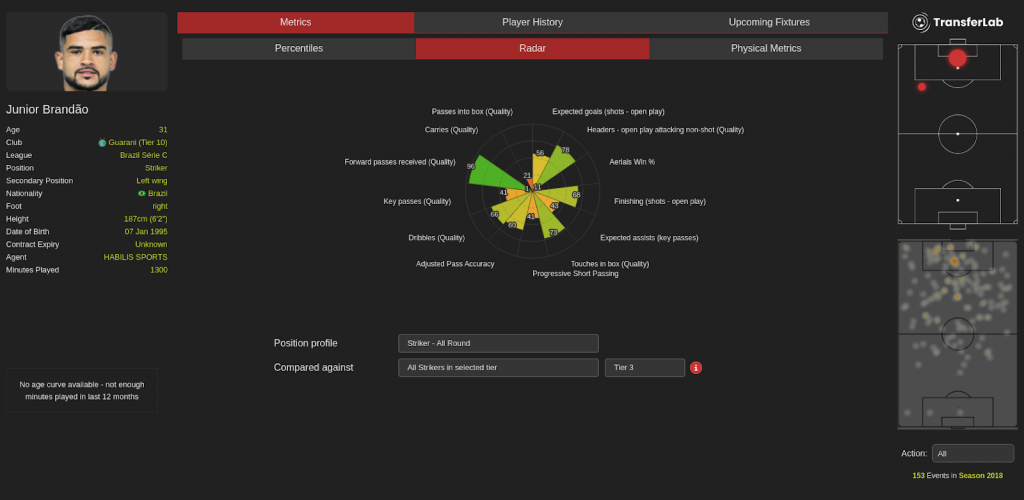
The Eagles have not always been successful with their younger signings from Brazil. Pedro Henrique’s €900,000 fee did not prove money well spent as he only made a solitary appearance for them before leaving permanently. The only bigger flop might be Junior Brandão, whose departure earned €1.5m for Atlético Goianiense, but only resulted in two outings for Ludogorets. As TransferLab’s time machine feature helps us see, this was quite a punt as hardly any signs pointed to him being a big success in Bulgaria.
Final assessment
On the whole, Ludogorets’ track record clearly looks good enough with younger Brazilian players, seemingly contradicting what we said at the outset with regard to their strategic focus on generally pre- or peak-age players. The counterpoint from the club’s perspective might be that the better, younger players do not stick around long and quickly necessitate a search for replacements. Interestingly, though, the three oldest Brazilians to join the Eagles did not stick around for more than a couple of years, despite all having moved across from domestic rivals. While they did consistently feature in the intervening period, worse yet was the fact that they left on free transfers.
All nine Brazilians to have made over 100 appearances for Ludogorets were between the ages of 22 and 25 years old when they were signed, so the idea of bringing in players approaching peak age evidently seems to be one that makes sense for the club’s needs. However, it would seem that looking for underrated young prospects to supplement them rather than bringing in proven and experienced figures might be a better approach in order to maximise the team’s ceiling. Despite their domestic dominance, the Eagles have only reached a continental Round of 16 once, all the way back in 2013/14. Their league performances leave little room to doubt the solidity of their foundations, so they perhaps might have been better off taking some more calculated risks on youngsters in the last decade.
Of course, there are many factors behind Ludogorets’ current position in the Bulgarian standings, so their transfer strategy for Brazilians can only tell a small part of the story. Indeed, they have been diversifying more in recent years too, as their current squad comprises players of 19 different nationalities from all parts of the world, including West Africa and Scandinavia. This definitely is a sensible decision in light of our findings in the Shakhtar Donetsk piece, which uncovered the inflation of transfer fees out of Brazil. However, Ludogorets’ different needs mean that they might still be able to strike good deals for a different segment of players, so theirs is an approach that other clubs in similar positions could yet learn from.
Data from Transfermarkt
Header image copyright IMAGO / NurPhoto /Guiseppe Maffia