

In the latest instalment of the Transfer Gurus series, we look at a USL team doing things differently
United Soccer League has recently announced some pretty significant changes, due to launch in 2028. The league currently boasts 25 teams in its senior form, but the new set-up will see “USL Premier will serve as the top tier of a unified men’s professional pathway that also includes the USL Championship and USL League One. As part of this structure, the USL is aligning competition formats across divisions to support balanced schedules, credible movement, and future expansion”, according to the league’s website. Both the USLP and USLC will have 20 teams and promotion and relegation will be brought in, the league’s major point of difference to MLS. USL hopes that these changes will bring the league up to MLS’ level and it will certainly make for an interesting change to how US sports have traditionally functioned (in closed, franchise-operated leagues).
USL budgets are currently, however, far below what MLS teams can command and, as such, recruitment proves to be a trickier process. Many teams operate with part-time or remote staff, but those with acumen and access to tools or in-house data modelling can still find and secure interesting targets.
The league’s recruitment landscape
Much USL recruitment is, however, still done within the US, or targets American players abroad, with Mexico a favoured second destination. Of the 250 transfers done into the league in 2025, USL buying from USL dominates, with Next Pro and MLS close second and third. Mexican teams account for around 4%, while everyone else, including frees, make up 21%.
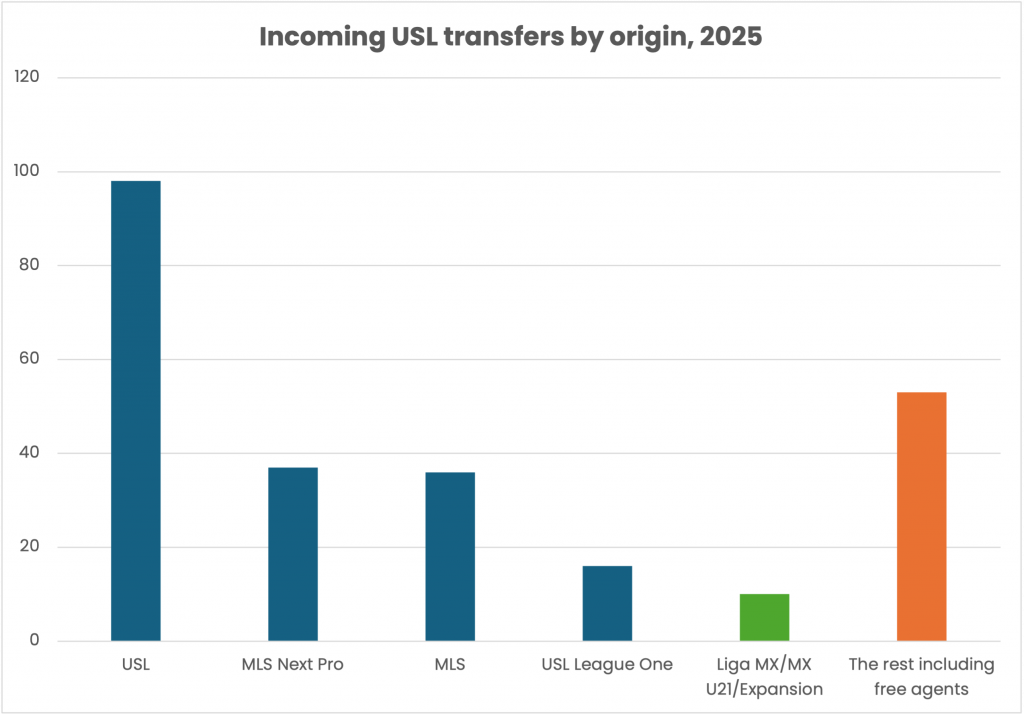
In 2025, 12 of 25 clubs only signed a player from other US teams, US players at foreign clubs, or free agents, while in 2024 it was 35%. Expense is the primary reason, with clubs simply unable to pay for scouting trips or hire multiple staff members with detailed knowledge of non-domestic football. This makes the clubs who do fish in foreign ponds interesting.
Along with Phoenix Rising, 2025 saw FC Tulsa, Monterey Bay FC, Las Vegas Lights, Rhode Island FC, Hartford Athletic, Birmingham Legion FC, and Miami FC sign more than one non-US player from a foreign club in 2025. Sporting Club Jacksonville, whose first season will begin March 2026, also signed more than one but have yet to debut in the league.
Meanwhile, Colorado Springs (Kyle Vassell from Kilmarnock), Loudon United FC (Thor Úlfarsson from Breidablik), Louisville City FC (Tola Showunmi from Crawley Town), and Tampa Bay Rowdies (Juan Carlos Azócar from Portuguesa FC) all brought in one player from a side neither US-based or Mexican. It’s also worth saying that Vassell and Azocar were returning to USL after stints away, while Showunmi was literally returning to Louisville, while Úlfarsson had played US college and then at Houston Dynamo.
With more than half of clubs signing at most one player from non-US or Mexican teams, clubs like Phoenix Rising stand out for their breadth and scouting vision, in a market where such an approach can bring success on and off the pitch.
Phoenix Rising’s varied approach
Probably no other team in USL (save maybe Monterey Bay or Miami FC) had a broader approach to recruitment last year than Phoenix Rising. Under Sporting Director Brandon McCarthy and head scout Jordan Florit, the Arizona-based club took players from Romania, Germany’s third tier, Mexico, Colombia, and France, as well as Next Pro and USLC. They joined players signed in 2024 from Azerbaijan, the Netherlands, Spain, and Switzerland.
McCarthy is an interesting front office head, with an MLB playing career that then saw him transition into being a special assistant to the GM at the Texas Rangers baseball franchise; he is also a part owner of Phoenix Rising. Florit, meanwhile, is an expert in South American football and has written a superb book about the sport in Venezuela, where he lives.
Under their leadership, the club have used a savvy combination of data and video scouting to unearth genuine talent, often looking for experienced players available from better leagues or promising talent.
Two of the most impressive signings from 2024, or mid-2025, before were Ihsan Sacko, signed from FC Thun, and Jearl Margaritha, signed from Sabah FK (while Ascel Essengue, loaned from LA Galaxy, who cleverly picked him up from Kadji Sports Academy in Cameroon, was also excellent).
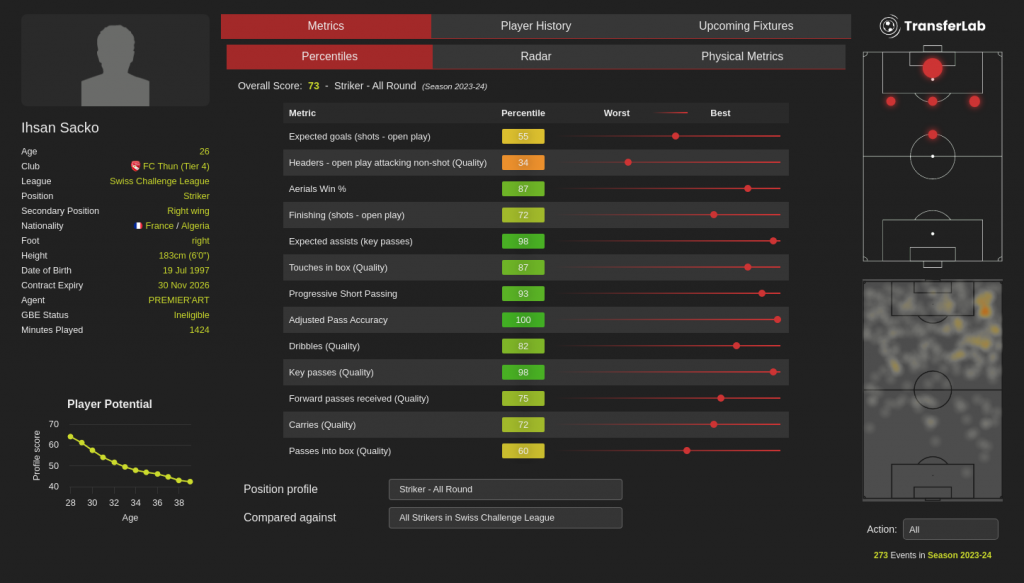
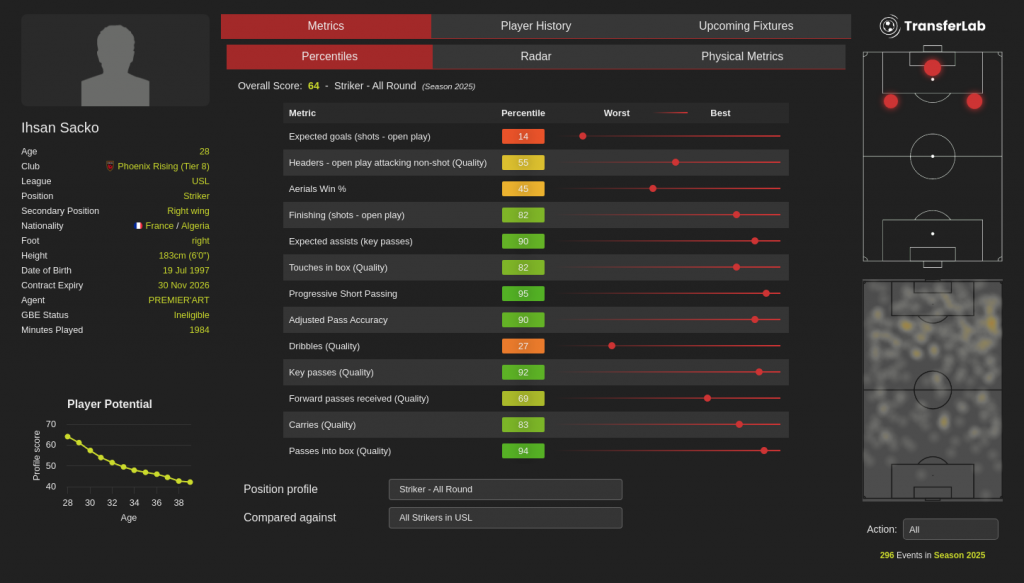
Sacko came through at Strasbourg and played Ligue 1 minutes for Nice between 2017/18 and 2019/20, but following that bounced around lower leagues before arriving at Thun in 2023/24. Sacko showed real creative excellence in his stint in Switzerland’s second tier (Thun were relegated at the end of 2019/20 and were only promoted again in 2024/25), a pretty comparable league to USL in terms of team strength. While Sacko’s expected goals numbers are relatively poor, he has largely maintained that excellence and managed seven goals and seven assists in 2025, leading PRFC for goal involvement.
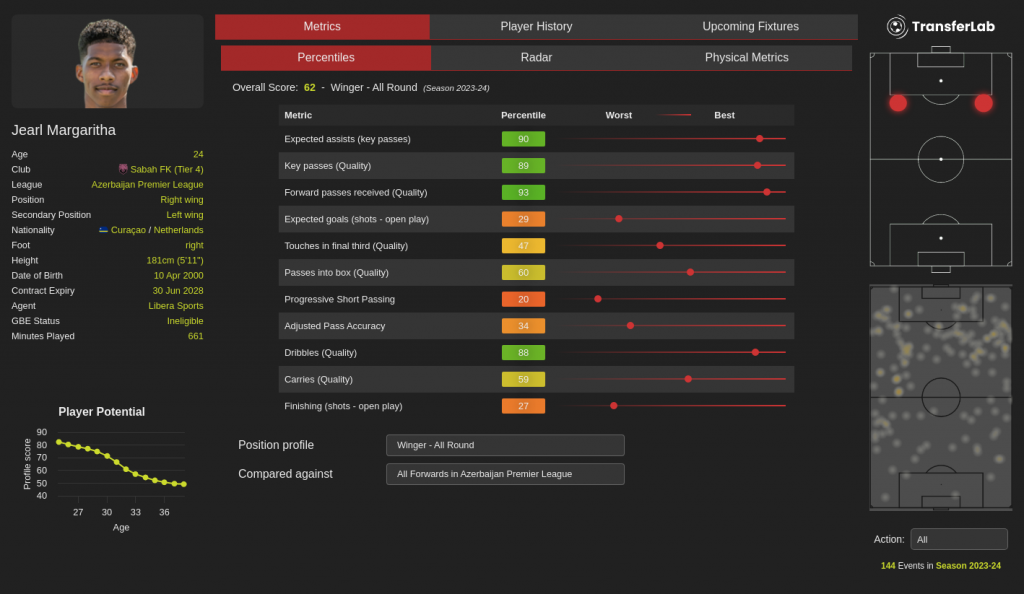
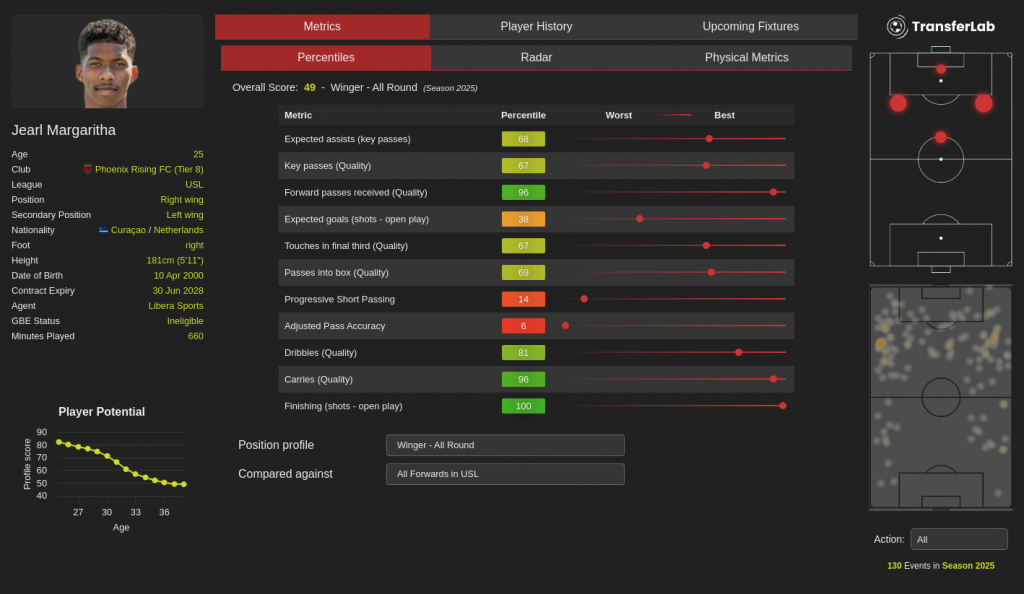
Margaritha was picked up on a free transfer from Sabah FK in Azerbaijan, where he played one full season following a €400k transfer from TOP Oss in the Netherlands. Margaritha profiled as passing creator, with elite levels for xA, key passes, and forward passes received, while his dribbling was also very strong. His weakness in other areas was mitigated by these strengths, and while the APL has some significantly weaker teams, the top end (Qarabg, Neftchi, Zira, and Sabah, are much stronger than USL sides. At PRFC, Margaritha’s passing quality dropped off, but he maintained top 10% levels in forward passes received and significantly improved the quality of his dribbling. His dynamism and on-ball quality drew the attention of SK Beveren in Belgium’s second tier, where he already has six goals and six assists.
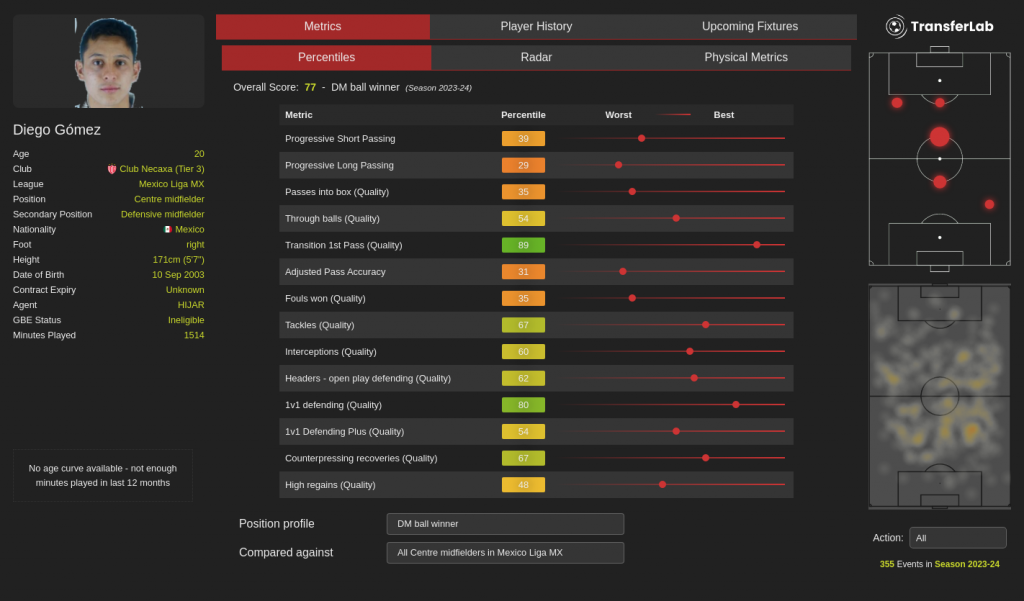
This season, the club has again cast the net wide. Probably the most impressive find is Diego Gómez, a tidy defensive midfielder who will probably play as an 8. In 2023/24, he racked up significant minutes for Necaxa and although his playing time dropped a lot in 2024/25, he maintained elite levels of defensive output. His transitional passing and all-round defensive ability was above average in a much stronger league (Liga MX) and so his in-possession game especially should scale comparatively in a weaker league set-up.
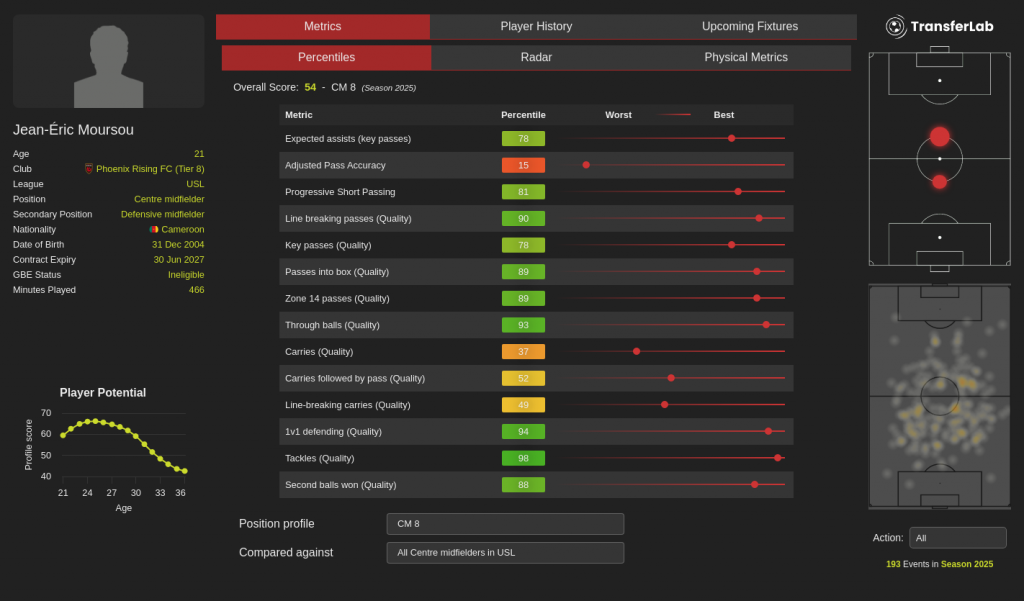
Another crucial signing was actually made last season, when Jean-Éric Moursou was taken on loan from Valenciennes (part of Sport Republic’s MCG). Moursou had a superb 2025 in Phoenix’s colours, putting up elite numbers for line-breaking passes, through balls, 1v1 defending, and tackles, and generally showing well-above league average quality in most facets of midfield play. Making the loan signing permanent brings back a player who has proven quality at the level and also knows the side, and head coach Pa-Modou Kah well.
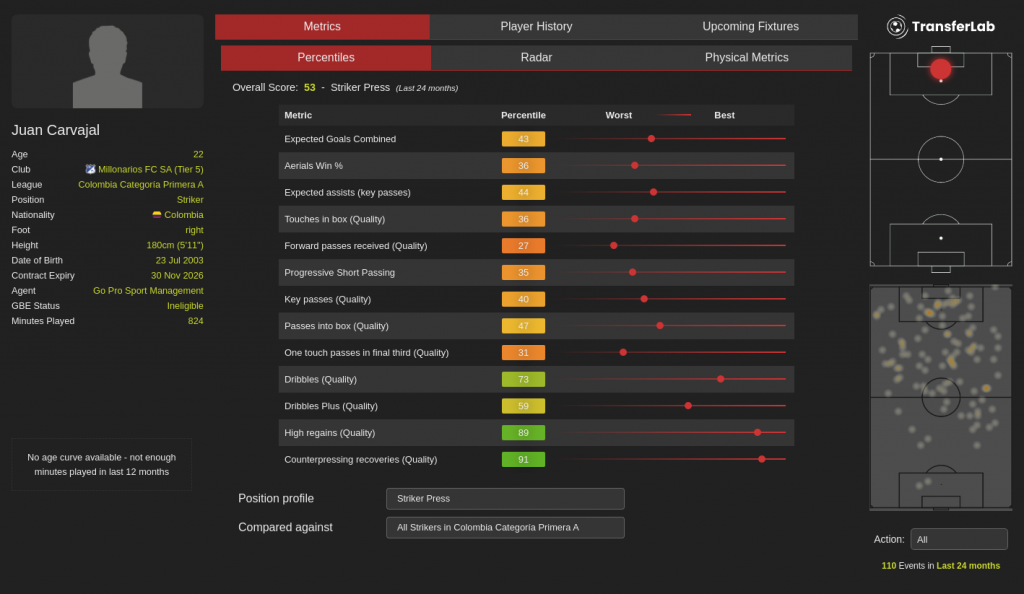
Lastly, Juan Carvajal was recruited from Millonarios FC. His data is harder to parse, given relatively limited minutes across the last few seasons at Millonarios and Internacional de Bogotá, but he shows promise as a pressing forward and has a great physical profile.
Importantly, all three players are in the pre-peak age range, assets that can deliver for the team in the short to medium term, while potentially providing a solid return on investment. Centre back Adrián Pelayo, who is a strong long passer and carrier, with a solid defensive win percentage, falls into this group at 19-years-old; the defender was recruited from Next Pro’s Vancouver Whitecaps II.
Phoenix Rising have shown that moving outside the traditional scouting grounds of USL can turn up excellent players, players able to offer first team performance and future returns. While budgetary restraints can feel like an impediment for some teams, for others, they encourage creativity and prove to be no real restraint at all. If the league is to develop as planned, other sides will want to look to clubs like Phoenix Rising for inspiration on how to increase their own talent pool.
Header image copyright IMAGO / ZUMA Press Wire / Patrick Magoon