
Bergas Brillianto looks at the surprise contenders for Denmark’s top flight championship and asks how they have managed it
I’ve always thought that Aarhus is a smaller version of Hamburg, the city where I live.
It’s no coincidence that they are both the second-biggest city in their respective countries. They are also both close to the water and have a harbour surrounded by lots of fancy, brand-new buildings.
The streets Graven, Klostergade and Borggade in Aarhus will easily remind you of the Sternschanze area and parts of the St. Pauli district in Hamburg. There are bars, restaurants and coffee shops where young people gather and hang out. The vibe is cool.
They also both have a football club that enjoyed success in the 1980s, but they haven’t been as good in recent years (they have both been relegated to the second league), although they are hoping to achieve something remarkable this season.
“AGF it’s a club that sees itself as a big club in Denmark, but it has not won anything for 30 years—and have not won a championship for 40 years. Maybe you can compare it a little to HSV,” Dennis Bjerre, a journalist from Aarhus Stiftstidende who is covering AGF, told me.
Yes, I agree. In this context, Aarhus has AG—I will continue to refer to them as Aarhu—and Hamburg has HSV. This article will focus on Aarhus, who are currently topping the Danish Superliga.
If we go back just a decade, Aarhus were only playing in the second division of the Danish league. However, unlike HSV, who spent several seasons in the second division, Aarhus managed to return to the top flight in just one season.
Since they were promoted back to the top flight, their best league achievement was finishing third twice (including the championship round).
It is therefore interesting to consider what has triggered their current dominance of the league. This is especially noteworthy since, according to Transfermarkt, Aarhus is only the fifth highest club in terms of market value.
Not only that, but they are also not currently in a strong financial position as they are in the process of building a new stadium, which is also experiencing problems and delays.
I know it might be too early, as the Danish Superliga is still far from finished. When I finished writing this article, the league had just played 20 games—it needed to play two more games to finish the first phase and then ten more to decide the league winner.
However, Aarhus are currently in the lead with 50 points, four ahead of the serious challenger FC Midtjylland in second place, with the championship phase about to begin.
For context, Aarhus have only previously been in first position after 19 games in the Superliga era once, back in the 1995/96 season. This is a huge achievement for them.
Historically, Aarhus have not really had a good reputation for dominating the league. Yes, they have won the first division five times, but their last title was in the late 1950s. Their last title was won a long time ago: 1986.
In their current state, sitting ahead of clubs like Midtjylland and Copenhagen, who have dominated the league in recent seasons, is an achievement that deserves recognition, whatever the final result.
“The last couple of seasons under Uwe Rösler (the previous coach, now with Bochum in 2. Bundesliga), there was a feeling that this group of AGF players maybe had a last dance in them,” Dennis told me.
However, last season was not their last dance. The core players of Aarhus have shown that they can compete this season, and perhaps even more. challenge for the title.
They are one of the reasons why Aarhus is top of the Danish Superliga. “This group has a strong bond and knows each other inside out,” Dennis added.
Of the 23 players in the Aarhus squad this season, 14 have been at the club since 2023. This is not the result of one or two years’ work.
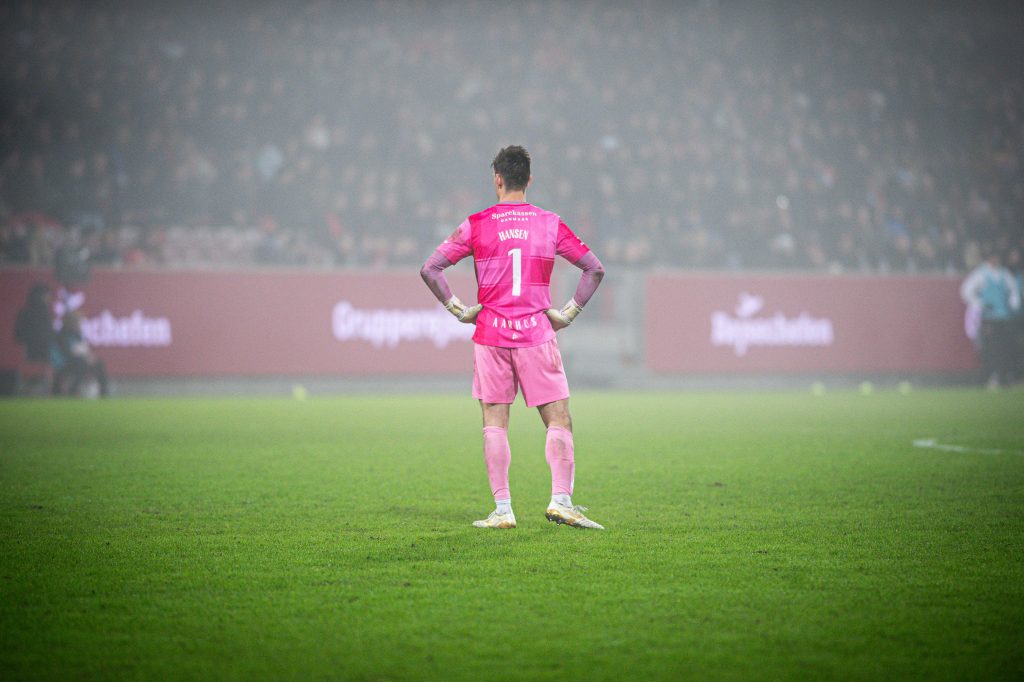
Their main goalkeeper, Jesper Hansen, who is 40 years old, has been at the club since 2021. Their main striker and last season’s Danish Superliga top scorer, Patrick Mortensen, has been at the club since 2019.
Meanwhile, their current star, Gift Links, who is just 27 years old, has been at the club since 2019, when he was just 21. Centre-back Erick Kahl, who is just 24 years old, has been at the club since 2021, when he was just 20.
Aarhus have also seen the rise of Tobias Bech this season. The club signed him from the German club FC Ingolstadt in 2023, and he has scored 10 league goals so far this season.
This is all the more impressive given that they have lost some important players in recent seasons.
Last season, they lost two of their best players: Mads Emil Madsen and Mikael Anderson. Madsen moved to league competitor FC Copenhagen.
In the 2023/24 season, they sold three notable players. Aarhus sold Yann Bisseck to Inter Milan, Thomas Kristensen (also playing for the Denmark national team) to Udinese, and Adam Daghimi to RB Salzburg (now in the Bundesliga with Wolfsburg).
The remaining strong core squad and Aarhus’ proven ability to find talent is also thanks to their two former sporting directors, Stig Inge Bjørnebye (yes, the former Liverpool player) and Peter Christiansen (now at Wolfsburg).
These two are responsible not only for most of the current squad’s core players, but also for finding players that they sold at a good price (I’m using €1 million as a minimum).
| Players AGF Aarhus sold for more than €1 million since 2019/20 season | |||
| Player | Sold to | Price | Season |
| Mads Emil Madsen | FC Copenhagen | €4.000.000 | 2025/26 |
| Mikael Anderson | Djurgaden | €2.000.000 | 2025/26 |
| Yann Bisseck | Inter Milan | €7.200.000 | 2023/24 |
| Thomas Kristensen | Udinese | €5.000.000 | 2023/24 |
| Adam Daghim | RB Salzburg | €3.000.000 | 2023/24 |
| Albert Grønbaek | Bodo/Glimt | €4.800.000 | 2022/23 |
| Mustapha Bundu | Anderlecht | €2.800.000 | 2020/21 |
| Jens Stage | FC Copenhagen | €2.000.00 | 2019/20 |
The players sold at a good price are also the foundation of Aarhus’ rise this season, as the club is not in the best financial situation to buy replacements due to the construction of a new stadium.
For context, the new stadium was supposed to be ready for this season, but it will now open next year (if there are no further delays). As a result, Aarhus has to play in the small stadium, which of course impacts their income.
“The stadium should be ready in a year, but it might take a little longer. The club has spent in the wrong side of 10 million euros on the new stadium and the small stadium they are using now,” Dennis explained.
“They say that they still got money for transfers, but it is obvious that they have sold big and are using the money they got from Anderson and Madsen to buy new players,” he added.
Of course, credit also needs to go to Aarhus’ current sporting director, Carsten Jansen. It is thanks to his strategy that Aarhus are in this position.
Let’s not forget that Aarhus successfully sold some of their stars for good money, especially the young ones. This season alone, they earned €6.97 million from selling their players.
Jansen could follow in the footsteps of his predecessors by investing the money in finding other young players who could be sold for a high price in the future. However, he took a different route.
The man who joined the club in January 2025 decided to go for ‘ready-to-go’ players instead. Of the five players he signed this season, all of them are over 23.
Among them is Markus Solbakken, a Norwegian national team player with Champions League experience from his time at Sparta Prague.
Jansen also bought former loan player Magnus Knudsen for €1.75 million from the German club Holstein Kiel, while Rasmus Carstensen was loaned from the Bundesliga side FC Köln.
These three players have become key members of the Aarhus squad this season, while Sebastian Jorgensen and Aksel Halsgard have established themselves as valuable squad members.
| AGF Aarhus Transfer 2025/26 season | |||
| Player | Bought from | Price | Age |
| Markus Solbakken | Sparta Prague | €2.000.000 | 25 |
| Magnus Knudsen | Holstein Kiel | €1.750.000 | 24 |
| Mads Hedenstad | Lillestrøm | Free transfer | 25 |
| Rasmus Carstensen | 1.FC Köln | Loan | 24 |
| Sebastian Jorgensen | Malmö | Loan | 25 |
Looking at these players, Jansen didn’t really take a risk. Not only do they already have experience, but they also have Scandinavian origins or have already played with the Danish club. This helps to reduce their adaptation time, making them ready to help the team straight away.
The result is clear: these new signings, along with Aarhus’ core players, have made the team stronger than last year (based on their current league position, at least).
This feels like a brilliant strategy at the right time to strengthen the squad and make them ready to compete now, as competitors like FC Copenhagen are currently struggling and far from their usual form.
Jansen also doesn’t want to take risks with young players, as Aarhus made mistakes in the transfer market in the last season under Bjørnebye.
In the 2024/25 season, Bjørnebye signed young players such as Youssouph Badji, Leopold Wahlstedt and Richmond Gyamfi, who cost at least €900k, but they failed to have a positive impact on the squad.
“AGF have burned their fingers in the last years on some big money signings, and they are trying to play it safe now,” Dennis said.
Well, it paid off. Jansen might have realised that Aarhus had bought themselves time in the past, and that the time to see the result is now, this season. It’s time to compete.
Jansen also deserves credit for his decision to appoint Jakob Poulsen as the new head coach last summer, replacing Uwe Rösler.
Poulsen is a young coach, aged only 42, who had experience with only one club prior to Aarhus: Viborg FF.
Under Poulsen’s leadership, Viborg successfully avoided relegation from the Danish Superliga for two consecutive seasons, despite having been promoted only in 2023. This achievement convinced Jansen that Poulsen was the right choice for Aarhus.
Initially, expectations were very low. “Nobody thought that AGF would do this well under Jakob Poulsen. People thought that they would fight for top 6 and start building a new team for the future—and for the new stadium,” Dennis told me.
Now, Aarhus are not only at the top of the league. They have only lost twice and conceded 20 goals in 20 games, which is still the best record in the league.
Although they have only scored 39 goals so far, the underlying numbers suggest that they should have expected to score 43.33 goals. With that in mind, Aarhus have the highest xG in the Danish Superliga after 20 games. They have been performing at a level that deserves to put them at the top of the league.
Having watched several of their games this season, I found their style of play under Poulsen interesting. They generally defend in a compact 4-3-3 and switch to attack in a 3-4-3 formation with a narrow front three.
When they have the ball, Aarhus are very patient, with focus on progress through short passes. For context, in the Danish Superliga this season, Aarhus are third from bottom in terms of long passes per 90 minutes.
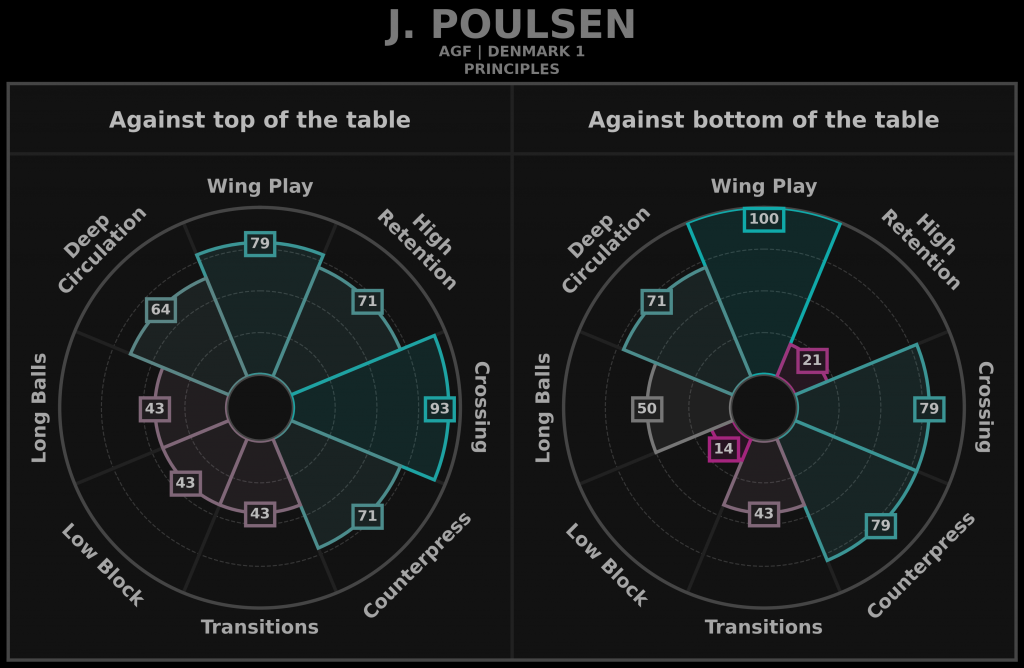
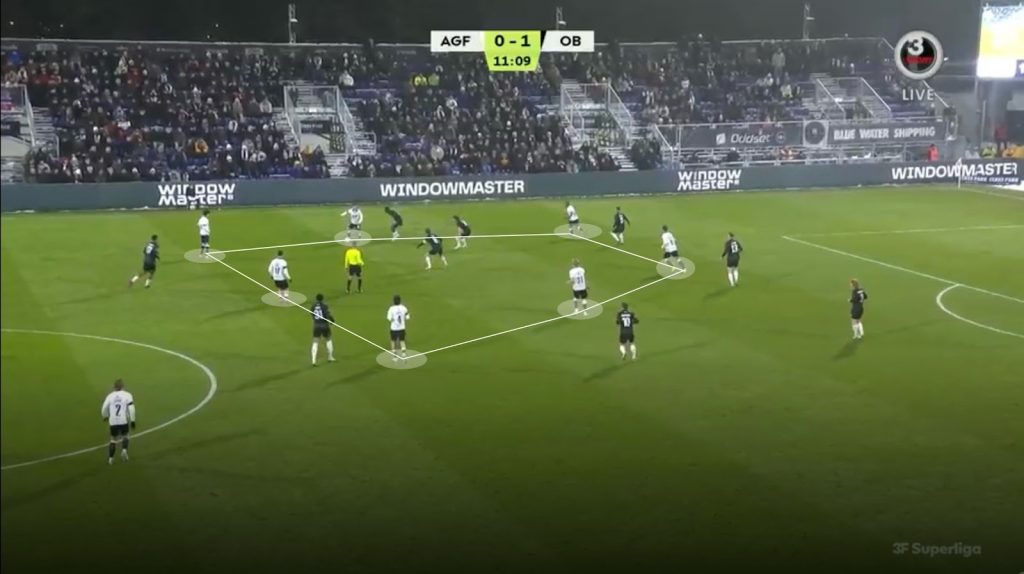
During the early in-possession phase, Aarhus usually form a 3-2-5 or 3-1-6 structure, with the wing-backs pushing forward to provide width. From there, they usually move the ball to the side where they can create an overload to ensure progression and reach the final third, or specifically the opponent’s penalty box.
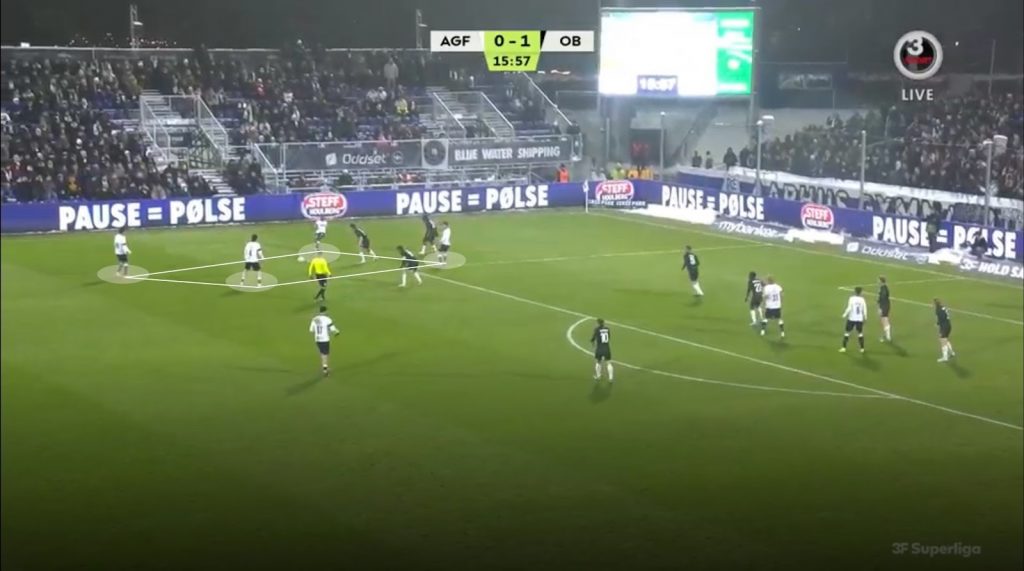
Their midfielders are flexible enough to move to the side and accompany the number ten and the wing-back, ensuring the attack continues. They do this through combinations.
Under Poulsen, Aarhus do not focus solely on maximising individual quality to overpower the opponent. Their one-on-one dribbling statistics, for example, are lower than those of teams such as Midtjylland, Nordsjælland and Copenhagen. However, their success rate is higher than those teams—Aarhus want to ensure that their actions are well calculated to create chances to attack.
Interestingly, their main method of attacking the penalty box is crossing. While many modern football teams do not consider crossing to be an effective way of creating chances, Aarhus under Poulsen seem to think differently.
They average around 18.5 crosses per 90 minutes this season, while FC Copenhagen, the second highest team, averaged only 15.5. Aarhus also ensure their crosses are dangerous: Although their accuracy is only 31.4%, 15% of their crosses reach the small box inside the penalty area. This, alongside the strategy to always erase numerical-inferiority in or around the opponent’s box, increases their chances of getting high-quality shots, which is why they have the highest xG in the league.
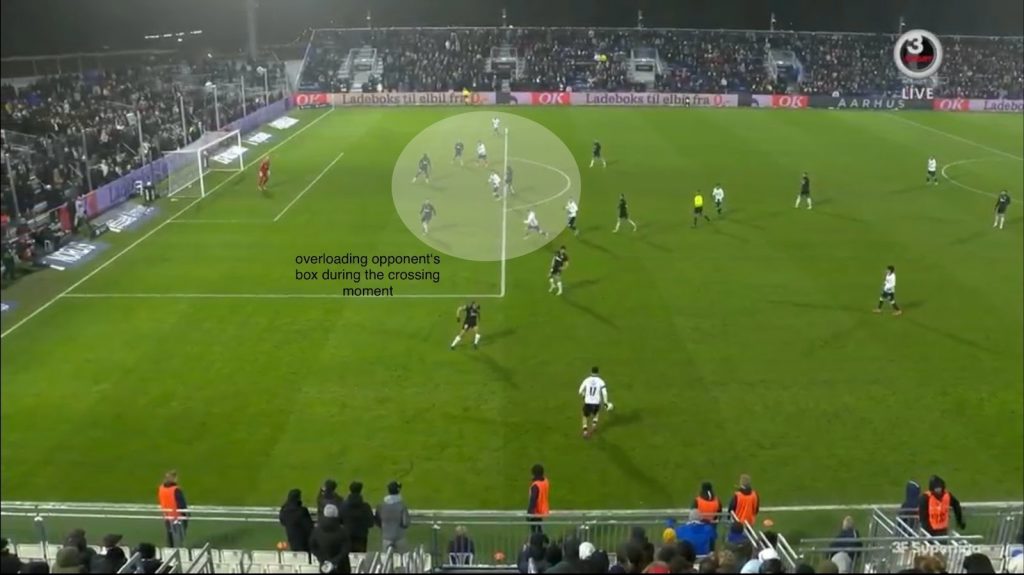
In this context, their star player, Gift Links, is the main reason for this success. He is averaging 4.88 crosses per 90 minutes this season—the highest number in the league. Links has also created more chances than any other player, totalling four assists so far.
Upfront, Tobias Bech has also performed well, with his positioning and off-the-ball movement helping him to score 10 league goals. These aspects of his game are helping Aarhus a lot, since opponents’ defenders usually focus on marking Patrick Mortensen.
“Kristian Arnstad has been key in Poulsen’s system. He was moved from midfield to a left 10 and he’s been so good. He’s on the ball all the time, everything goes through him,” Dennis gave another insight, with Arnstad scoring seven goals and creating two assists so far.
Out-of-possession wise, especially in terms of pressing, Aarhus are not the most intense team off the ball. At least if we measure by PPDA (passes allowed per defensive action), since in this regard they are only fourth, with teams like Copenhagen and Midtjylland being far more intense.
However, Aarhus know how to put the opposition under pressure during the build-up process. They usually press the opponent’s build-up with a man-to-man approach, aiming to force them onto the wings.
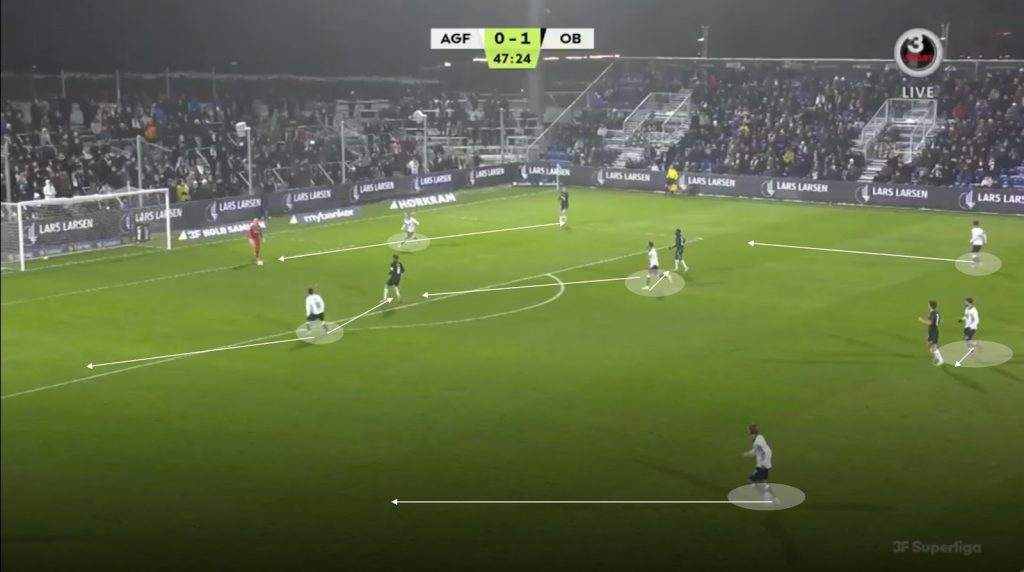
Once the opponent reaches the sideline, Aarhus apply pressure and overload to force the opponent to either send a long ball, make a mistake or pass the ball back. By ensuring the opponent is unable to play a short build-up and progress through the centre, Aarhus minimise the chance of facing a high-quality attack.
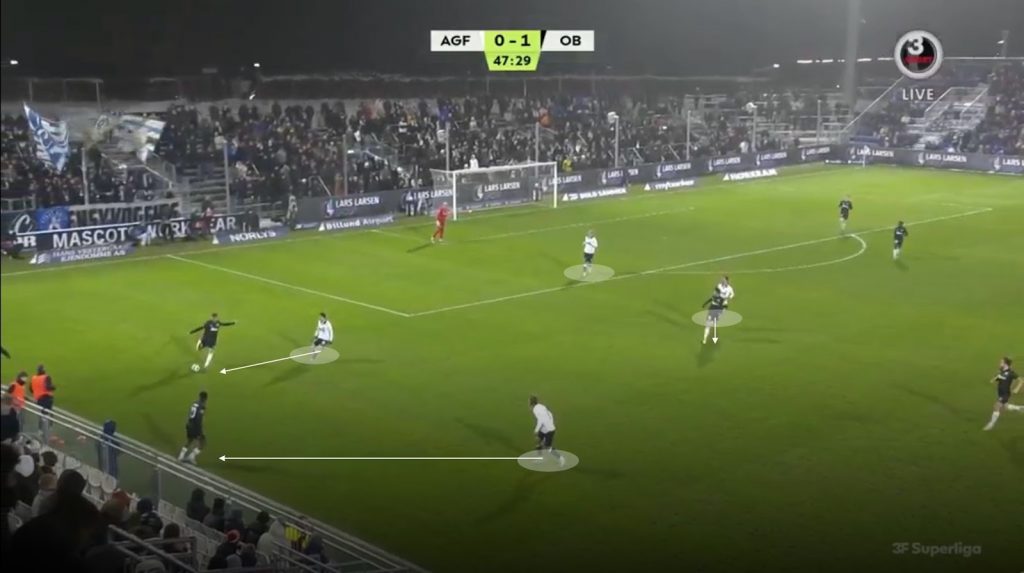
In general, Aarhus have also been a great defensive team in the Danish Superliga for the past few seasons—last season they were the best defensive team in the first phase of the league, and the season before that they were second.
“The success this season is a combination of Jakob Poulsen’s positive football thoughts. And the foundation—especially defensive—that Uwe Rösler built,” Dennis noted.
The Danish Superliga is still a long way from finishing. Aarhus still need to prove that they are strong enough in the Championship Round to win the title this season.
However, given their current financial situation due to the construction of a new stadium, what they have achieved so far deserves huge credit.
In this context, the strategy of their sporting director, Carsten Jansen, to focus on “ready-to-go” players in recent transfers has made Aarhus stronger. Their core players, who know each other well, are maturing and know how to elevate the team.
This is complemented by their new coach, Jakob Poulsen, who has a strong platform who, in my opinion, focuses heavily on patience, short passes, brave crosses and man-to-man pressing. Also, aside from the tactical aspect, Poulsen is the figure the squad needs to step up.
“Jakob Poulsen is much more of a modern leader compared to Rösler. He believes in trust where Rösler is more a control kind of guy. And the core group of players really needed that new leadership,” as Dennis said.
This season might end well for them, as they have been waiting a long time for glory. However, this does not mean that Aarhus should forget their identity as a club that is well-known for producing and developing great talent.
“They miss a group of new young talents—or at least they did under Uwe Rösler. Nothing new was coming from the academy,” Dennis said, but maybe they will do it after a season or two of great achievements.
Header image copyright IMAGO / Gonzales Photo / Morten Kjaer