
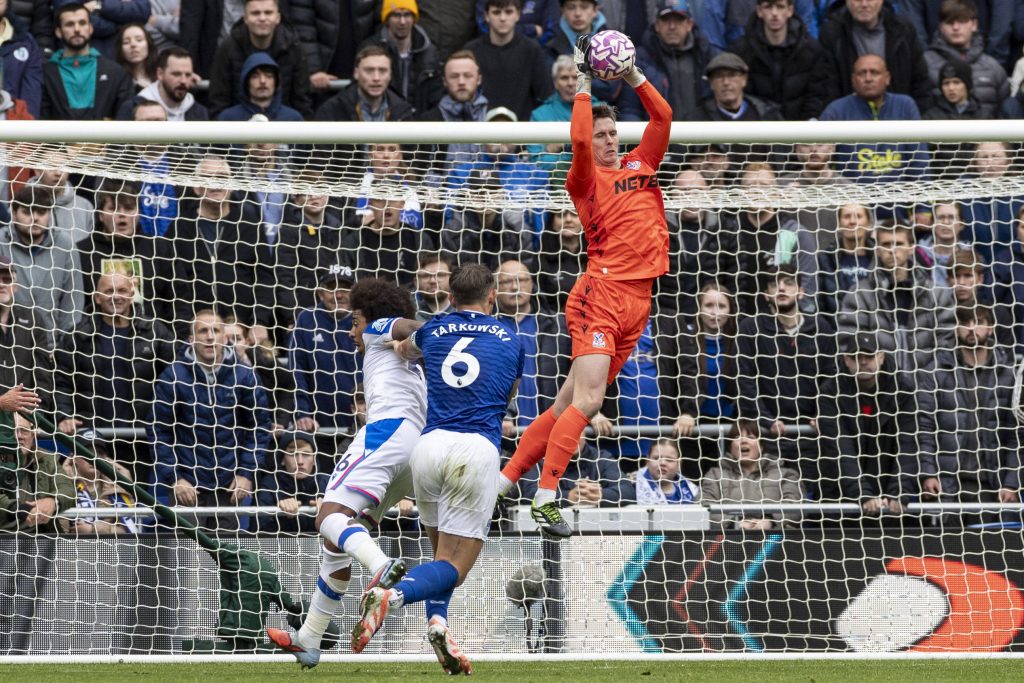
Looking to other sports can sometimes yield interesting ways of combing through and analysing data. NHL enthusiast Alex Stewart delves into a metric used to assess ice hockey goaltenders
A recent article on The Athletic addressed consistency in NHL goalies. According to Jesse Granger, “If there’s one trait NHL coaches desire most from their starting goaltender, it’s consistency.
Having a goalie stand on his head and single-handedly win a game is great, but it’s also rare at the highest level. Knowing a goalie will make the saves he is supposed to make, and play well enough for his team to earn points on a nightly basis, can inspire confidence and elevate the play of the entire team.”
This makes sense, especially so in a sport where goalies can face 20-30 shots per game, regularly. Of course, football sees shots far less frequently, but consistency is still a much-desired quality, especially when it is linked to the concentration and focus required to pull off stops behind possession-heavy teams.
In The Athletic piece, Granger references an NHL metric for goalkeepers, which is commonly referred to as “quality start percentage”. To calculate it, one simply divides the number of starts a ‘keeper makes where they reach or exceed a certain save percentage by the total number of starts.
In the above piece, Granger picks .900 (90%) for his threshold, but that is far too high for football. Instead, to assess this season’s Premier League ‘keepers we opted for a 70% threshold. Around half of the goalkeepers in Europe’s top five leagues have managed an overall save percentage of 70%, which is generally considered good for a top level ‘keeper, so it seems like a fair cut-off point. In addition, we excluded ‘keepers with fewer than 10 starts, and removed starts where the ‘keeper did not have to make a save at all (David Raya, for example, has five of these).
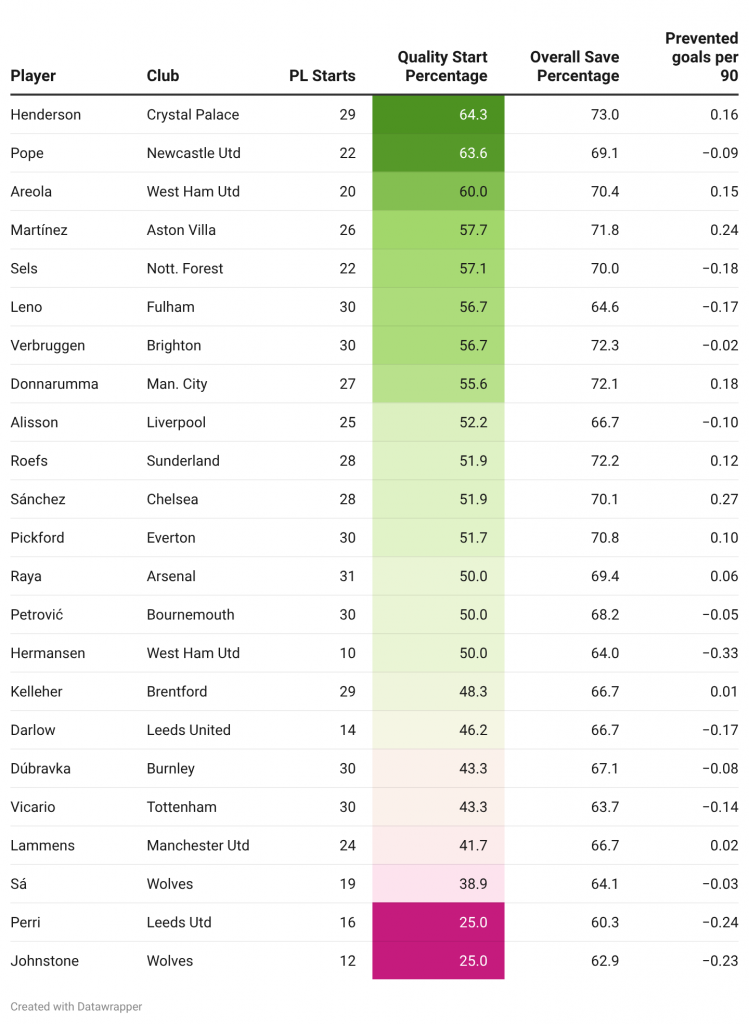
The top three goalkeepers in the Premier League this season so far for Quality Start Percentage are Dean Henderson, Nick Pope, and Alphonse Areola. The Crystal Palace, Newcastle United, and West Ham goalkeepers reach a save percentage of 70% or higher in more than 60% of their matches.
At the other end of the table, Sam Johnstone (Wolves), Lucas Perri (Leeds United), and José Sá (Wolves) are the least consistent.
Now, as Granger points out in his article, some of the most match-winning goalkeepers for save quality (Vasilevskiy and my NHL team the Islanders’ Sorokin) are not in the list because, as he says, “their performances have had higher peaks and lower valleys”.

In order to get a better all-round picture, we need to compare consistency with goals prevented, a measure of how goalkeepers perform relative to the quality of shots they face (using Wyscout data now that FBref’s PSxG +/- model is no longer public), to see who is consistent and who prevents goals.
Firstly, it’s worth saying that there is only a weak positive correlation between goals prevented and quality start percentage (0.47). This is because you can prevent a high number of goals by making big stops from high xG chances, while also letting in softer goals from middling areas, which may then reflect poorly on your consistency. In addition, goalkeepers can be generally solid and consistent, but let in low value chances from range every now and again, which would count heavily against their prevented goals per 90.
The graph below shows quality start percentage against prevented goals per 90, and highlights Henderson, Martínez, Areola, and Donnarumma as the four ‘keepers most effectively combining consistency with quality goal prevention. Pope, Leno, and Sels are the keepers who are consistent in their save percentage, but let in more goals than expected. Sánchez has strong prevented goals numbers, but is less consistent than 10 other keepers, while Verbruggen, who has improved significantly as the season has progressed, is pretty consistent and performs only slightly below expected in terms of prevented goals.
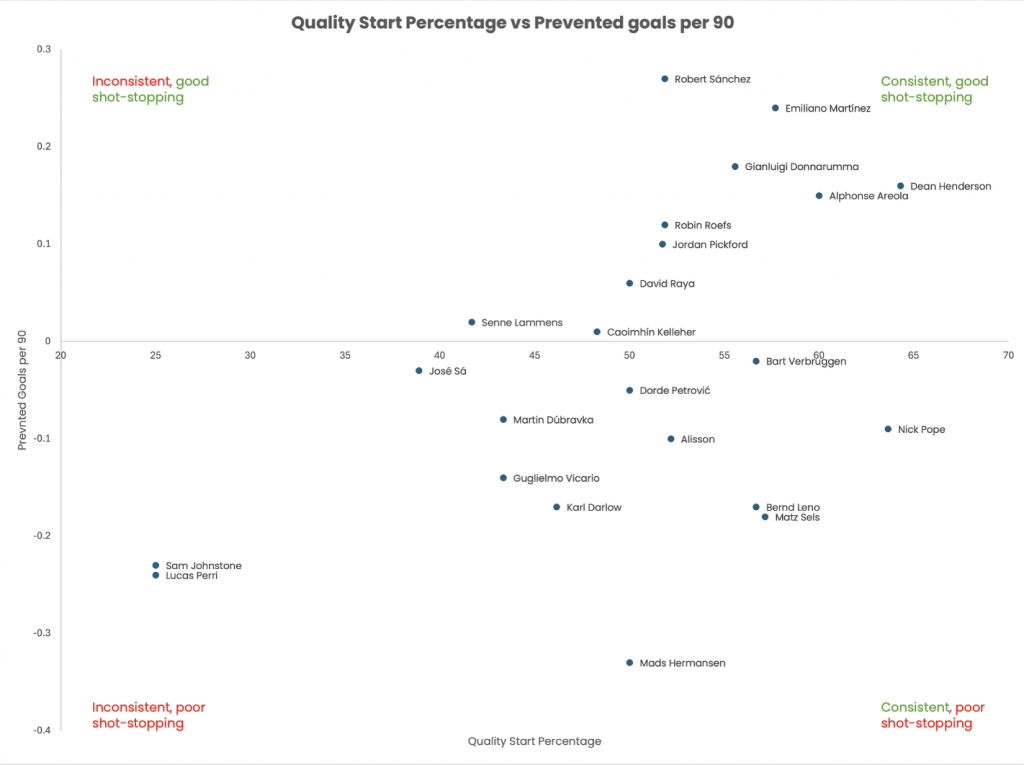
It’s also worth looking quickly at overall save percentage against quality start percentage. The correlation here is obviously much stronger (0.78) – it is worth highlighting Roefs, who has obviously been comparatively inconsistent but has the third highest overall save percentage in the league, and pretty strong prevented goals.
It is also interesting that the average number of starts for those with a quality start percentage is 25.9, while the average number of starts for those under 50% is 21.75; it’s 15.7 for those under 40%. Those three ‘keepers also have the lowest overall save percentage, but it’s worth reminding readers that Sá has had two of the statistically most impressive goalkeeping season in the last five years (2021/22 and 2023/24) and is performing more or less in line with quality of shots faced.
The table below lays out the data for those interested.
So what does this tell us? Firstly, given the comparatively lower shot volume in football (compared to ice hockey) save percentages can jump around a lot more, so this metric is probably not as generally useful for football as it is for ice hockey. That said, consistency is hugely important, and if you can find a goalkeeper with a high save percentage, a high quality start percentage, and a good prevented goals return (although this is the noisier metric), then you very likely have a good all-rounder who makes saves, doesn’t make many mistakes, and gets the team points against the expected.
By that all-round measure, the best ‘keepers currently in the Premier League would be Dean Henderson, Emi Martínez, and Alphonse Areola, with honourable mentions for Roberto Sánchez, Gianluigi Donnarumma, and Robin Roefs, which meets the eye test as well.
Header image copyright IMAGO / NurPhoto